Regional Licensing Nuances Shaping Reward Pathway Diversification Across Digital Reel and Table Ecosystems
Devon Vogel · Jun 23, 2026

Regional Licensing Nuances Shaping Reward Pathway Diversification Across Digital Reel and Table Ecosystems
Regional licensing frameworks establish distinct boundaries for how operators structure reward pathways in digital reel environments versus interactive table ecosystems, and these rules create measurable differences in bonus eligibility, loyalty tier progression, and promotional mechanics across jurisdictions. Data from multiple regulatory bodies shows that slot-focused reward systems often face stricter contribution caps on certain game types while table game pathways permit broader multiplier applications tied to live dealer participation rates.
Licensing Structures in North American Markets
State-level authorities in the United States apply varying standards that directly affect how reward pathways diversify between reel-based titles and table offerings. Operators licensed in New Jersey must adhere to contribution percentages set by the Division of Gaming Enforcement, which limits how quickly players advance through loyalty tiers when focusing exclusively on digital reels, whereas table game activity receives higher weighting in some compliance models. Pennsylvania's regulatory approach, administered through the Pennsylvania Gaming Control Board, permits operators to offer differentiated bonus structures that accelerate table game progression while maintaining separate caps for reel-based rewards, creating parallel yet distinct advancement routes.
Canadian provincial frameworks add another layer of variation. Ontario's Alcohol and Gaming Commission of Ontario requires clear separation between reel and table reward calculations, which encourages operators to maintain independent loyalty ladders that reflect the distinct risk profiles and session lengths typical of each category. Those who've examined compliance filings note that these separations prevent cross-subsidization between game types while still allowing unified account management for players.
European Regulatory Variations and Their Effects
European licensing regimes produce additional diversification patterns. Malta's regulatory environment, overseen by the Malta Gaming Authority, allows operators to bundle reel and table rewards under unified progressions provided that game-specific return-to-player disclosures remain transparent. In contrast, several other EU member states enforce stricter segmentation that forces operators to maintain separate bonus pools and tier requirements for each ecosystem. This segmentation influences how players experience progression speed, particularly when switching between reel sessions and live table interactions within the same platform.
Observers note that these licensing differences become especially visible during promotional periods when operators adjust reward multipliers according to jurisdictional caps. Data collected across multiple platforms indicates that table game pathways often receive more flexible multiplier application in markets with unified licensing, while reel-based rewards encounter tighter daily or weekly limits designed to manage volatility exposure.
Asia-Pacific Licensing Approaches
Asia-Pacific jurisdictions introduce further complexity through market-specific rules on reward distribution. Australian state regulators require operators to publish detailed breakdowns of how reel and table contributions feed into loyalty programs, which results in transparent but segmented progression systems. Several Southeast Asian licensing bodies impose additional geographic restrictions that limit reward pathway access based on player location, creating localized versions of both reel and table ecosystems within the same operator portfolio.
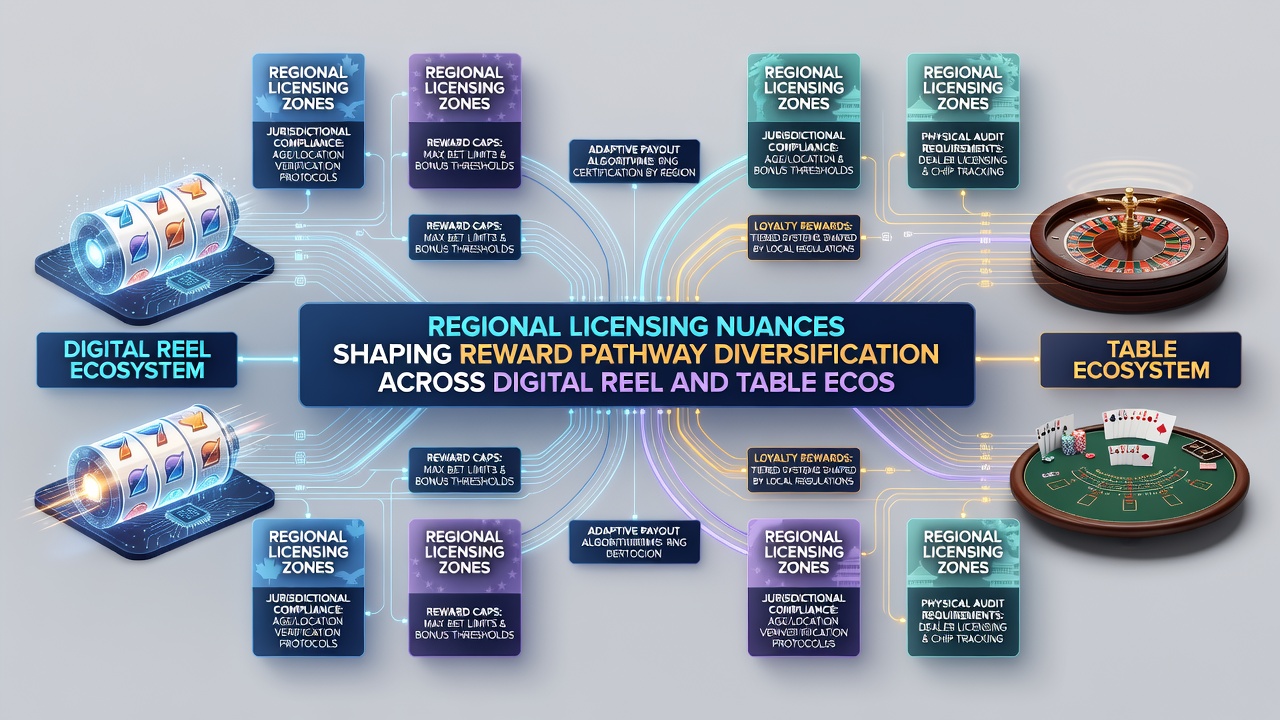
Research indicates that operators respond to these regional requirements by developing modular reward engines capable of applying different contribution rules based on player jurisdiction. This technical adaptation allows platforms to maintain consistent user interfaces while automatically adjusting underlying progression mechanics to satisfy local licensing conditions.
June 2026 Developments and Emerging Patterns
Regulatory updates released in June 2026 across several jurisdictions highlighted ongoing refinements to how licensing conditions shape reward diversification. Multiple state and provincial agencies issued revised guidance documents clarifying contribution percentages for new game categories, which further separated reel-based and table-based reward calculations in affected markets. These adjustments prompted operators to recalibrate loyalty program structures, particularly in regions where hybrid play patterns had previously blurred category boundaries.
Industry reports compiled during this period show increased adoption of region-specific reward modules that automatically detect player location and apply the corresponding progression rules. This development reduces compliance friction while preserving the distinct reward pathways that licensing frameworks require for digital reel and table ecosystems.
Conclusion
Regional licensing nuances continue to drive measurable diversification in how reward pathways function across digital reel and table ecosystems. Operators maintain compliance by implementing flexible systems that respect jurisdictional differences in contribution weighting, tier progression, and promotional mechanics. These adaptations ensure that players encounter reward structures aligned with local regulatory standards while operators preserve operational consistency across multiple markets.